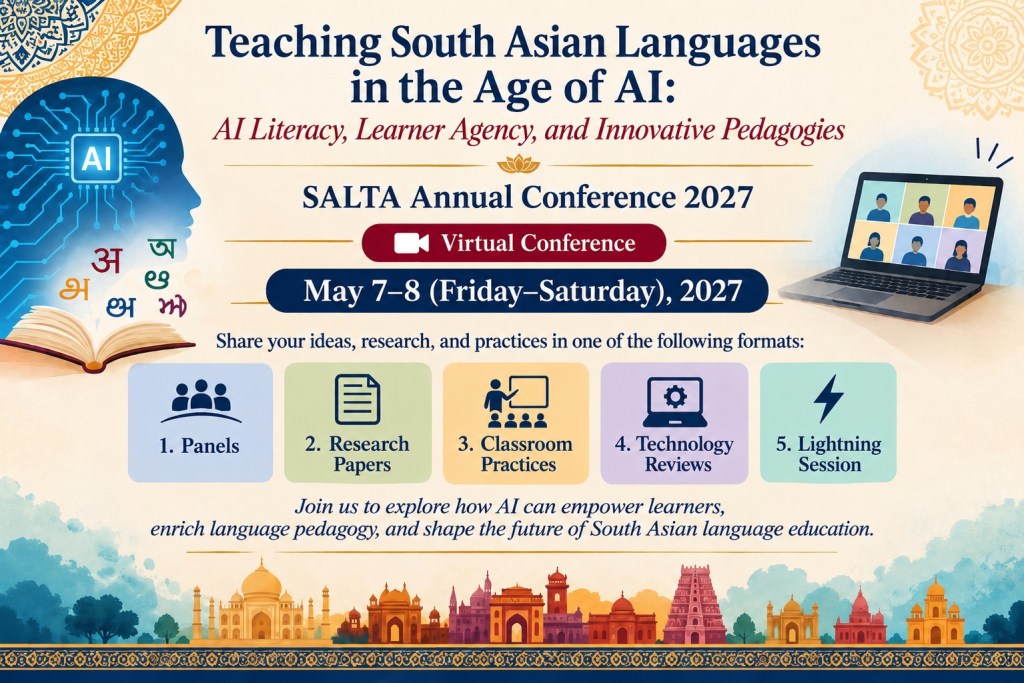
Conference Theme:
Teaching South Asian Languages in the Age of AI: AI Literacy, Learner Agency, and Innovative Pedagogies
Dates: Friday and Saturday, May 7–8, 2027
Format: Two-day online international conference
The rapid emergence of generative artificial intelligence (GenAI) is transforming language teaching, learning, assessment, materials development, and research. Technologies such as ChatGPT, Gemini, Claude, voice-based AI, automated translation, speech recognition, and other AI-powered applications are creating new possibilities for language education and beyond while simultaneously raising important questions about accuracy, ethics, cultural representation, learner autonomy, privacy, and academic integrity, accessibility, and intercultural competence.
For teachers and scholars of South Asian languages, literature, and culture, these developments are particularly significant. Languages such as Hindi, Urdu, Bengali, Punjabi, Gujarati, Marathi, Tamil, Telugu, Malayalam, Kannada, Nepali, Sinhala, Sanskrit, Persian, Tibetan, and other less commonly taught languages continue to face challenges related to limited instructional materials, uneven digital resources, smaller learner populations, and relatively limited representation in language technologies. Although GenAI can potentially help address some of these challenges, AI-generated materials and interactions may also contain linguistic inaccuracies, cultural misunderstandings, inappropriate registers, fabricated information, and biases resulting from uneven representation in training data.
The 2027 SALTA Conference invites educators, scholars, researchers, graduate students, instructional designers, technology specialists, and language professionals to explore how we can reimagine South Asian language teaching and learning in an AI-mediated world.
Submission Formats
The 2027 SALTA Conference will accept submissions in five formats:
1. Panels
90 minutes; 3 presenters
Panel proposals should include:
- Panel title
- 50-word panel abstract that briefly describes all papers.
- Individual abstracts of 200–300 words for each presentation
- Names and affiliations of all presenters
2. Research Papers
20-minute presentation + 10-minute Q&A
Research papers may report:
- Empirical research
- Quantitative or qualitative studies
- Mixed-methods research
- Classroom-based research
- Longitudinal studies
- Experimental or quasi-experimental studies
- Case studies
- Action research
- Theoretical or conceptual research
3. Classroom Practices
20-minute presentation + 10-minute Q&A
Reports may address:
- AI-integrated lessons (all skills)
- Technology-enhanced instruction
- Open Educational Resources (OER)
- Project-based learning
- Experiential learning
- Translanguaging
- Intercultural activities
- Heritage language pedagogy
- Proficiency-based instruction
4. Technology Reviews
20-minute presentation + 10-minute Q&A
Reviews might address:
- Generative AI platforms and conversational tools.
- Pronunciation technologies
- Speech recognition
- Automated translation
- Digital dictionaries
- Language-learning applications
- Corpus tools
- Assessment technologies
- Accessibility tools
- Indigenous and endangered language technologies
5. Lightning Session
This session offers an alternative to typical poster presentations. In this session, you can brainstorm research or classroom practice ideas
- Each lighting session is 10 minute presentation + 5-minute Q&A
- Submit your proposal here by April 10, 2027:
- Here is the link: Everyone, including those presenting on the panel, needs to fill out this form. SALTA form
- Registration: Free for SALTA members; $35 for professionals; $25 for students.
- Join us in sharing ideas that place students at the center and enrich language education around the world.