Job Opportunity: Senior Learning Designer, Indian Languages (Duolingo)

Duolingo is seeking a Senior Learning Designer, Indian Languages to help shape innovative language-learning experiences.

The ideal candidate will be a senior language educator and curriculum designer with:

  • Training in linguistics
  • Deep expertise in Hindi
  • Strong knowledge of the cultural and linguistic diversity of India and the broader South Asian region

Learn more and apply here: https://careers.duolingo.com/jobs/8722385002?gh_jid=8722385002

Please share with interested candidates and relevant networks.

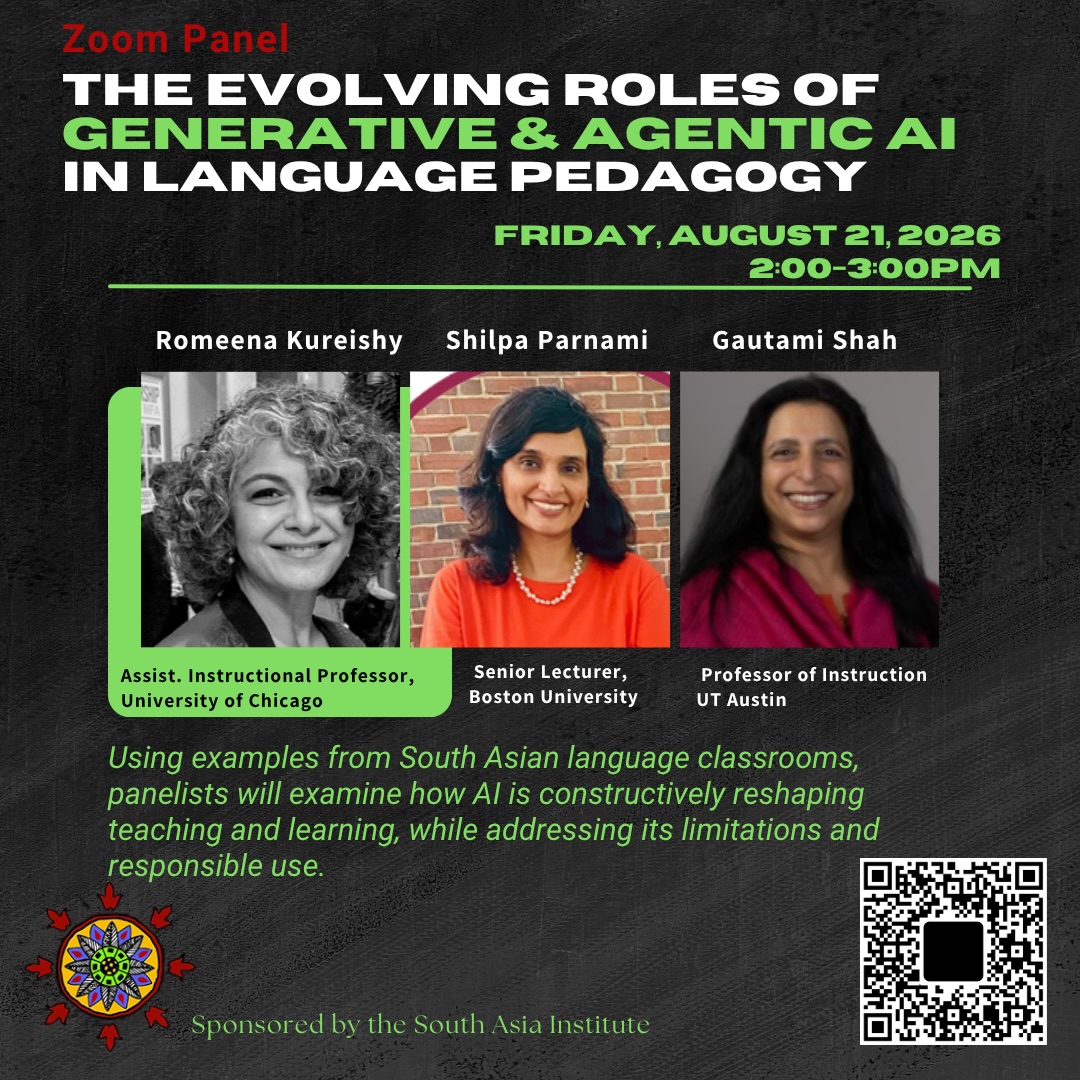
The Evolving Roles of Generative and Agentic AI in Language Pedagogy

Date: Friday August 21, 2026

Time: 2:00 PM – 3:00 PM

Location: Zoom

Zoom Panel: "The Evolving Roles of Generative & Agentic AI in Language Pedagogy"

AI is part of our daily life and is here to stay, quickly transitioning from being a novelty to becoming a useful tool in many contexts, including language pedagogy. Our students are already accustomed to engaging with AI through gamification. The challenge to language instructors now is to recognize the creative potential and understand AI as an entire new medium in the pedagogy. Creatively employed, AI can go a long way to ensure our students are appropriately engaged, thereby resulting in improved linguistic and interactional proficiency. 

Through several concrete examples from South Asian language classrooms, Profs. Romeena Kureishy, University of ChicagoShilpa Parnami, Boston University, and Gautami Shah, University of Texas at Austin, will highlight the constructive use of AI (generative and agentic) in language pedagogy, along with limitations and potential abuse. 

This event is free and open to the UT community and the general public.

 REGISTER HERE!

Sponsored by:South Asia Institute at UT Austin

Add to

SALTA Seeking Treasurer 2026

Dear SALTA members, 

Please join me in thanking Vasu Renganathan for his 6 years of service as a SALTA board member, serving as treasurer. 

The South Asian Language Teachers Association (SALTA) is now seeking nominations and applications for the position of Treasurer. The Treasurer plays a vital role in supporting the association’s financial health and transparency and works closely with the Executive Board to oversee SALTA’s financial operations.

  1. Qualifications: 

Thorough understanding of financial reports and able to translate financial concepts/information to the board.

SALTA member for at least two years and has actively participated in SALTA activities, including conferences and workshops.

  1. Duties:  

The Treasurer will: 

• maintain the bank account,  

• collect and deposit all checks,  

• oversee and keep accurate books of account of SALTA’s financial transactions, 

• approve fundraising initiatives, expenditures, and reimbursements, 

• prepare an annual financial report to be presented at SALTA’s annual meeting,  

• assist the President in annual filing and reporting requirements.

  1. Term of Office and Renewal: 

The Treasurer will hold a term of office of two years, with a possibility of two renewals for a maximum of six years. 

Please fill out this form if you’re interested in serving as a SALTA board member in the capacity of treasurer. The applications will be accepted till September 30th, 2026.

This is a voluntary position, and no financial compensation is provided.

SALTA Workshop for Hindi teachers and South Asian language educators

From Script to Classroom: Using Theatrical Storytelling to Teach Hindi Through Read-Aloud, Interpretation, and Discussion

Date April 18th, Saturday, 3 to 4

By Mayuri Raman Nayan

Abstract

This workshop introduces Hindi teachers to a practical, lesson-based approach to theatrical storytelling. Using a short play script from Rangdarpan as the model text, the session demonstrates how dramatic reading, guided interpretation, and classroom discussion can be shaped into an engaging language lesson. Rather than treating a script only as literature to be read silently, participants will explore how voice, pauses, emotional cues, and character perspective can help students listen more closely, speak more confidently, and connect more deeply with language and culture. The workshop emphasizes low-pressure, classroom-friendly strategies that do not require stage experience, making the approach accessible for both virtual and in-person teaching. Teachers will leave with a ready-to-adapt lesson model they can use with other short plays, dialogues, and narrative texts in their own Hindi classrooms.

Target Audience

  • Hindi teachers and South Asian language educators
  • Heritage language and world language instructors
  • Teachers interested in storytelling, theatre, and experiential learning
  • No prior theatre background required

What Participants Will Learn

  • how to design a performance-based Hindi lesson around a short dramatic text
  • how to use read-aloud strategies to support comprehension, pronunciation, fluency, and interpretive skills
  • how to guide students to notice voice, pause, tone, emotion, and character perspective while reading a script
  • how to build pre-reading, during-reading, and post-reading tasks that make language learning active and meaningful
  • how to teach vocabulary and expressions through dialogue, context, and character interaction rather than rote explanation
  • how to connect interpretive, interpersonal, and presentational communication through one shared classroom text
  • how to adapt the same script for different proficiency levels and for both online and in-person Hindi classrooms

Session Structure

Session FlowWhat it includes
Opening and context
(5 min)
A brief framing of theatrical storytelling and why dramatic reading works so well in language classrooms.
Model lesson with
Rangdarpan script
(15–20 min)
Participants experience a short play excerpt through read-aloud, voice modulation, emotional cues, character perspective, and minimal performative choices.
Discussion and reflection
(10–15 min)
Teachers discuss meaning, interpretation, cultural context, learner response, and ways to scaffold the script for their own classes.
Classroom application
(5 min)
Practical ideas for adapting the method across proficiency levels in online and in-person Hindi classrooms.

Why This Workshop Matters

In many virtual and hybrid classrooms, language learning can start to feel flat or overly text-bound. This workshop offers a more human, voice-centred approach. Theatrical storytelling invites learners to hear rhythm, feel emotion, notice intention, and respond to language as lived expression rather than as isolated vocabulary or grammar alone. Because the method relies on presence, listening, and imagination rather than staging or memorization, it is especially useful for teachers who want an interactive classroom practice that is simple, adaptable, and culturally grounded.

About Mimansa

Mimansa is a storytelling and learning initiative that blends theatre, literature, and pedagogy to create engaging, culturally rooted educational experiences. Its work uses narrative and performance as tools for connection, reflection, and language learning across age groups and proficiency levels.

Hindi-Urdu Poetry Recitation Competition for all University Students in America.

The South Asian Language Teachers Association (SALTA) is a non-profit, professional organization registered in the state of Tennessee. Its mission is to advance and improve the study and teaching of South Asian languages and cultures, promote research in linguistics and literatures, support educators, and foster professional collaboration.

Jhilmil-America and Hindi Se Pyar Hai are two non-profit organizations based in NJ that are engaged in promoting Indian Art, Culture, and Literature in the USA.

Together, we are planning to organize Hindi/Urdu Poetry Recitation and Poetry Writing Competition open to all University Students in America.

Objective – Encourage students to write & recite Hindi Poetry and develop the necessary skills

There will be two competitions

1.    Original Poetry – Students recite their own poetry.

2.    Poetry Recitation – Students can recite poems written by anyone.

Cash Awards and certificates will be given to the winning candidates. All participants will receive a Certificate of Participation from World Hindi Secretariat, Mauritius.

We also plan to enroll interested students in ‘Kavita Ki Pathshala’, a virtual school run by ‘Hindi se Pyar Hai’ Group, where experts in different genres of Poetry teach students the rules and grammar of Poetry. Volunteers run the school, and it is completely free.

The preliminary round will happen online on Sunday, April 26th, 2026. 

The final round of the competition will be part of the SALTA 2026 Conference, being held on Friday, May 8th, 2026 online.

https://docs.google.com/forms/d/e/1FAIpQLSeWgewlUiF9wDa0pvIcDcTs8JQp5tid9oPC7frBlO4PIPGbrA/viewform

SALTA Monthly Book Club- Yogita Yadav

Date and Time: Sunday, April 26, 2026
Time: 12:00–1:00 PM Eastern Time  (10:30–11:30 PM India Time)
Led by: Dr. Kusum Knapczyk
Language: Hindi-Urdu

The story is in Hindi and can also be read in the Roman script, so Urdu readers will be able to read it as well.

https://www.hindwi.org/story/ghalat-pate-ki-chitthiyan-yogita-yadav-story

About the author

Yogita Yadav is an important writer of contemporary Hindi literature. She was born in 1981 in Delhi, and her writings offer a sensitive and vivid portrayal of women’s psychology and social concerns. Her first short story collection, Clean Chit, was published by Bharatiya Jnanpith in 2014, and she received the Navlekhan Award for it. Her novel, Khwahishon ke Khandavvan, along with many well-known stories, has given her a distinct literary identity. Along with literature, she continues to work on social and women-centered issues and has been honored with many awards.

  1. क्लीन चिट – कहानी संग्रह, 2014 में भारतीय ज्ञानपीठ से प्रकाशित।
  2. ख्वाहिशों के खांडववन – उपन्यास, 2017 में प्रकाशित।
  3. आस्था की अर्थव्यवस्था – जम्मू-कश्मीर की सामाजिक और आर्थिक संस्कृति पर आधारित लेखों का संग्रह।
  4. गलत पते की चिट्ठियाँ – कहानी संग्रह, उनके नाम से उपलब्ध।
  5. नए घर में अम्मा – प्रकाशित कहानी संग्रह के रूप में उपलब्ध।

Instructor in Hindi Language at Duke University

The Department of Asian and Middle Eastern Studies at Duke University in Durham, North Carolina invites applications for an Instructor in Hindi language beginning August 1, 2026. This position is for one academic year (2026 to 2027) with the possibility of renewal based on departmental needs. The teaching load includes four courses per year.Applicants must hold a PhD in fields such as Second Language Acquisition, Indian Studies, or a related area. Candidates should have native or near native proficiency in both Hindi and English. Preference will be given to applicants with experience teaching undergraduate students in North America and the ability to teach Hindi at both elementary and intermediate levels. Experience with instructional technologies, comfort with team teaching, and active engagement in the professional field are also desirable. Applicants must be authorized to work in the United States.To receive full consideration, please submit your application by April 1, 2026. Applications should include the following: 1. A letter of application with a statement of teaching philosophy 2. Curriculum vitae 3. A teaching portfolio that includes syllabi, sample teaching materials, and student evaluations 4. Names and contact information for three referees (The search committee will request recommendation letters during a later stage of the process)Applicants must apply here:https://academicjobsonline.org/ajo/jobs/31871Duke University and The Department of Asian & Middle Eastern Studies are strongly committed to advancing inclusive excellence throughout our research, teachings, and service activities. We seek to hire faculty who are passionate about working to increase the participation and success of individuals from different backgrounds and communities. Duke University is an Affirmative Action/Equal Opportunity Employer committed to providing employment opportunity without regard to an individual’s age, color, disability, gender, gender expression, gender identity, genetic information, national origin, race, religion, sex, sexual orientation, or veteran status.

Duke is an Equal Opportunity Employer committed to providing employment opportunity without regard to an individual’s age, color, disability, gender, gender expression, gender identity, genetic information, national origin, race, religion, (including pregnancy and pregnancy related conditions), sexual orientation, or military status.

Duke aspires to create a community built on collaboration, innovation, creativity, and belonging. Our collective success depends on the robust exchange of ideas—an exchange that is best when the rich diversity of our perspectives, backgrounds, and experiences flourishes. To achieve this exchange, it is essential that all members of the community feel secure and welcome, that the contributions of all individuals are respected, and that all voices are heard. All members of our community have a responsibility to uphold these values.

Job: Visiting Assistant Professor in Hindi-Urdu, Wake Forest University

Dear colleagues,

I’m writing to let you know that the MESAS program at Wake Forest University has opened a search for a Visiting Assistant Professor in Hindi-Urdu Language and Culture to begin on July 1, 2026.

Here is a link to the announcement: https://apply.interfolio.com/183405

I would appreciate your help in spreading the word to potential candidates.

Best regards,

Peter
— 

Peter Knapczyk, PhD

Assistant Professor of Hindi-Urdu

Middle East/South Asia Studies Program

Wake Forest University

website: http://hindiurdu.wfu.edu/

office: Carswell 318

email: knapczp@wfu.edu

phone: 336-758-6238

New Book: An Alchemy of Words and Silences: Contemporary Hindi Women Poets

Dear friends,

We are delighted to share the arrival of An Alchemy of Words and Silences: Contemporary Hindi Women Poets, an important new book by Rekha Sethi, translated into English by Hina Nandrajog.

Published by Routledge, this 236-page volume offers an in-depth and accessible exploration of seven major Hindi women poets: Gagan Gill, Katyayani, Anamika, Savita Singh, Neelesh Raghuwanshi, Sushila Takbhoure, and Nirmala Putul. Alongside thoughtful critical essays, the book includes translations of selected poems and situates each poet within the social, cultural, and historical contexts that have shaped their work.

Bringing together Dalit, Adivasi, urban, and rural voices, the book presents a rich and varied landscape of contemporary Hindi poetry. Rather than framing women’s writing only as resistance to patriarchy, it explores the layered intersections of gender, identity, sexuality, and social justice. It also traces the broader history of women’s writing in India, showing how today’s poets both inherit and reshape the feminist legacy for the twenty-first century.

This volume will be a valuable resource for students and scholars of Literature, Comparative Literature, Gender Studies, Sociology, and Translation Studies. Most importantly, it places contemporary Hindi women poets firmly at the centre of academic conversation, inviting readers, researchers, and translators worldwide to engage with this vibrant and powerful literary tradition.

# Gender, Identity, Self, Feminism, Feminist, Intersectionality, Dalit, Adivasi, Ecology, Body, Sexuality

Key Details:

Author: Rekha Sethi

Translator and Editor: Hina Nandrajog

Publisher: Routledge Oxon and New York (Taylor & Francis Group)

Publication Year: 2026

DOI: 10.4324/9781003716815

You can find more information on the links below or purchase a copy through Amazon India or Routledge.

An Alchemy of Words and Silences: Contemporary Hindi Women Poets – Rekha Sethi – Google Books https://share.google/XGOJJ1wpakjICiOuO